
Buying a Business? Revenue Is Not What You Are Buying.

Buying a Business? Revenue Is Not What You’re Buying

What small business owners should examine before putting their capital and the business they already built at risk.

13 min read

banquet image

Buying an existing business can look like a shortcut to growth.

Instead of starting from scratch, you may be acquiring an existing customer base, equipment, employees, a recognizable name, a location, operating systems, future contracts and an established stream of revenue, but there is an important question every buyer should answer before discussing financing:

What economic benefit are you actually buying?

A business can generate hundreds of thousands of dollars in annual revenue and still be a poor acquisition. A seller can have invested hundreds of thousands of dollars into building a company without the company being worth that amount today. And a profitable business can still create a cash-flow problem if the acquisition is financed improperly.

Through AEMC’s Small Business Growth Initiative (SBGI), our financial advisory team recently helped an established entrepreneur evaluate the proposed acquisition of another operating business.

The seller’s asking price was approximately $200,000. On the surface, the opportunity looked like growth. Once we began analyzing the financials, however, the story became much more complicated.

“A great business can still be a bad acquisition at the wrong price.”


SBGI TIP: Understand what the price is actually buying before you finance it.

01

Revenue Is Not the Same Thing as Economic Benefit

One of the easiest numbers to focus on when evaluating a business is revenue. “How much does the business make?” It’s an understandable question—but it’s incomplete. If a company generates $400,000 in revenue but requires nearly all of that money to pay employees, rent, inventory, contractors, utilities, insurance, repairs, marketing and management, the buyer isn’t acquiring $400,000 of economic benefit.

Revenue is not what you’re buying. You’re buying the economic benefit that remains after the revenue pays for everything required to produce it.

That distinction became particularly important in our recent acquisition advisory engagement. The entrepreneur considering the purchase was already operating established businesses and generating meaningful revenue. She understood from experience that strong sales don’t automatically translate into strong owner compensation or cash flow. Adding another company therefore couldn’t be evaluated simply by asking whether it would increase her total revenue. We needed to determine whether it would improve her economic position.
Advisor pointing to revenue charts on a laptop as a business owner reviews financial records
02

Start With the Tax Returns But Don’t Stop There

Historical tax returns can tell us a great deal about a business. In an acquisition analysis, we may examine several years of:
  • Business tax returns and financial statements
  • Balance sheets
  • Depreciation schedules and fixed assets
  • Bank statements and merchant-processing activity
  • Payroll and contractor expenses
  • Debt and shareholder loans
  • Customer contracts and future bookings
  • Lease obligations
  • Unusual or nonrecurring transactions
The objective isn’t merely to determine whether the paperwork exists. We’re trying to understand the economic story behind the numbers. In our recent engagement, the historical years showed substantial revenue but relatively modest reported operating results. That immediately created another question: What would those earnings look like after appropriate financial normalization?
Business owner reviewing stacks of tax returns and financial statements at her desk
03

Normalize the Earnings Before You Believe the Profit Number

Financial statements prepared for tax purposes don’t necessarily tell a prospective buyer exactly how much economic benefit the business can generate under new ownership. Certain items may need additional analysis. Depreciation, for example, is a noncash expense, so it may be appropriate to consider it when analyzing cash-generating capacity. A one-time gain from selling an asset, on the other hand, shouldn’t automatically be treated as recurring operating income. Then there’s owner compensation. Suppose the current owner performs substantial management, sales, administrative or operational work but takes little or no salary. That doesn’t mean the buyer gets that labor for free. After the acquisition, somebody still has to perform the work. If replacing the owner’s duties would reasonably cost $50,000 per year, that economic cost needs to be considered when determining what the business actually produces for its owner. This is why sophisticated acquisition analysis goes beyond simply accepting the bottom line shown on a P&L.
Advisor and business owner reviewing financial statements and charts to normalize earnings
04

When the Best Year Changes the Story, Verify It More, Not Less

Imagine this situation: Several historical years show modest profitability. Then the seller presents a recent year showing a dramatic increase in earnings. That doesn’t mean the newer number is wrong, but if that number materially changes what the business may be worth, it deserves more verification, not less. In our recent engagement, the seller’s most recent financial presentation showed substantially stronger profitability than the historical operating results we had reviewed. That made the latest year extremely important. Rather than simply inserting the higher profit into a valuation model, our advisory process identified the records needed to substantiate it. Ideally, there should be a trail: Customer activity → merchant/POS records → bank deposits → accounting records → tax filings The closer those records reconcile, the more confidence a buyer can have in the earnings being presented. A seller-prepared P&L tells you what the seller says happened.

Source documents help you determine whether the underlying economic activity supports the story.

Advisor pointing to a rising earnings chart as a business owner reviews binders of financial records
05

Follow the Cash, Not Just the Profit

A profitable business can still have weak cash flow. That’s why bank activity can be such an important part of acquisition due diligence. We may compare reported revenue against bank deposits as a high-level reasonableness test. We also look at where the money went. Was cash accumulating? Was the company continually operating near zero? Were there significant debt payments? Did the owner inject money into the business? Were large assets purchased? Were there distributions? Was there a major asset sale—and if so, what happened to the proceeds? None of these questions alone proves that something is wrong. They help us understand the difference between accounting profitability and actual liquidity. And for a buyer who may soon have acquisition debt, rent, payroll and working-capital requirements, liquidity matters enormously.
Two businesswomen reviewing receipts, bank records and cash flow charts with a calculator
06

A Seller’s Investment Is Not the Same as the Buyer’s Value

This is another area where buyers can easily get caught up in impressive numbers. A seller might say: “I’ve invested $300,000 into this business.” That may be completely true. But it doesn’t necessarily mean the buyer is receiving $300,000 of value. The seller may have spent money on renovations, equipment, furniture, décor, advertising, professional services, websites and other startup costs. Those expenditures need to be evaluated individually. Marketing expenditures may already have been consumed. Equipment may have depreciated. Furniture may be worth considerably less on the secondary market. Leasehold improvements may have significant operating value but little independent resale value—especially when the seller doesn’t own the building. The right question isn’t: “How much did the seller spend?” It’s: “What are the assets and economic benefits I’m receiving worth today?”

SBGI TIP: Historical investment explains what the seller spent. It does not, by itself, establish what the buyer should pay.

Buyer and advisor inspecting commercial kitchen equipment while taking notes on a clipboard
07

If You’re Buying a Leased Business, You’re Also Buying Into the Lease Economics

A beautiful buildout can become much less attractive if it comes with unsustainable occupancy costs. For a location-dependent business, we want to understand issues such as rent, escalation clauses, additional occupancy charges, lease term, renewal options, maintenance responsibilities, permitted use and whether the landlord will approve the buyer. This matters because a buyer may pay a premium for a “ready-to-operate” location only to discover that the cost of occupying that location consumes much of the business’s earnings. Leasehold improvements and location value therefore can’t be analyzed independently from the lease itself.

A great location under a bad lease can still produce a bad acquisition.

Business owner and advisor reviewing a floor plan and lease documents in an empty storefront
08

Goodwill Has to Survive the Seller

Goodwill is one of the more complicated components of small-business value. A company may have a recognizable name, website, social-media accounts, customer reviews and several years of operating history. But how much of that actually transfers to the buyer? We want to understand: Where do customers come from? How much business comes through referrals? Are there repeat or recurring customers? Does the website generate measurable leads? Does the company rank organically in search? Are future bookings already under contract? Are vendor relationships important? Are customers loyal to the company—or personally loyal to the owner? One of the most useful questions is: If the current owner disappeared tomorrow but the buyer kept the business name, phone number, website, location and customer channels, how much business would continue? That begins to separate enterprise goodwill from goodwill that may be attached primarily to the seller. And when a company has only been operating for a relatively short period, evidence becomes especially important. A young business can absolutely build meaningful goodwill—but a buyer should understand what creates it before paying a substantial premium for it.
Café owner introducing a prospective buyer to longtime customers in his shop
09

Don’t Pay the Seller for Growth You Will Have to Create

This is particularly important when an experienced entrepreneur buys another business. The buyer may already have:
  • An established customer base
  • A professional network
  • Industry relationships
  • Marketing capabilities
  • Complementary businesses
  • New service ideas
  • Better operating systems
  • Plans to expand utilization or introduce new revenue streams
Those capabilities may make the acquisition much more successful after closing. But whose value is that? If the buyer expects to double revenue because she will bring new customers, introduce new services, create partnerships and operate the company more effectively, that future upside isn’t necessarily goodwill created by the seller. It may be value the buyer will create after the acquisition.

Don’t pay today’s seller for tomorrow’s value that you will have to create yourself.

Projected growth can absolutely justify an acquisition decision. But buyers should distinguish between value they’re purchasing and value they’re planning to create.
Business owner and partner looking over an unfinished space beside a board of renovation plans
10

Future Contracts Aren’t Automatically Worth Their Face Value

A business with $50,000 of future bookings does not necessarily have $50,000 of additional value. Those contracts may require food, labor, supplies, entertainment, equipment, merchant fees or other costs to fulfill. Some deposits may already have been collected and spent. Contracts may have cancellation provisions. And the buyer may inherit the obligation to deliver the service. So the economic question becomes: What profit and cash flow are expected to remain after fulfilling those contracts? That is considerably different from simply adding future contract revenue to the purchase price.
Two businesswomen reviewing a booking calendar and project timeline with marked cancellations
11

Acquisition Debt Can Turn a Profitable Business Into a Cash-Flow Problem

A business may look profitable on paper and still struggle under an aggressive financing structure. Suppose the buyer has to make:
  • Acquisition loan payments
  • Seller-financing payments
  • Equipment or vehicle payments
  • Monthly rent
  • Payroll
  • Insurance
  • Inventory purchases
  • Working-capital expenditures
Loan principal generally doesn’t appear as an expense on the P&L. But the cash still leaves the bank account. That’s why acquisition modeling should include both profitability and cash flow. A transaction can produce accounting profit while simultaneously draining cash. For an entrepreneur who already owns another business, that creates an additional risk:

Will the acquisition support itself or will the existing company have to support the acquisition?

That’s a question worth answering before closing.
Advisor walking a business owner through a financing timeline for an acquisition
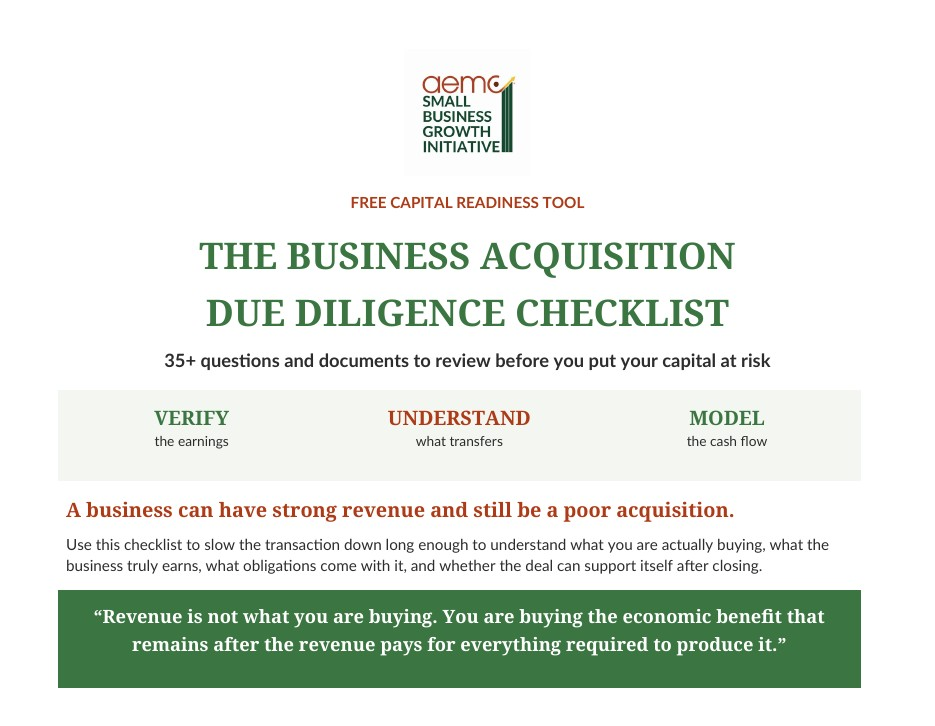
Cover of the SBGI Business Acquisition Due Diligence Checklist
✓35+ due diligence questions
✓Key financial areas to review
✓Practical tips and guidance
✓A decision readiness checklist

FREE RESOURCE

Business Acquisition Due Diligence Checklist

Get a step-by-step checklist to help you evaluate a potential acquisition before you commit.

Get the Free Acquisition Checklist →


Capital Readiness Is About More Than Getting the Loan

At SBGI, we provide financial advisory and capital-readiness technical assistance to help entrepreneurs make informed growth decisions — whether that means purchasing a business, expanding an existing one, or pursuing other opportunities.

❖

Personalized Advisory Support

⚙

Practical Tools and Resources

↗

Stronger Business Outcomes

APPLY NOW →

This article is for educational purposes and does not constitute a certified business valuation, appraisal, legal opinion, investment advice or lending commitment. The appropriate scope of financial, tax and legal due diligence depends on the specific transaction.